Ad Creatives
Create the ads that people see in their feeds.
Ads are the creative execution — the images, videos, and copy that people actually see in their feeds. While campaigns set objectives and ad sets define audiences, ads determine whether someone stops scrolling, pays attention, and takes action. Strong creative can overcome average targeting, but weak creative wastes even the most precise audience selection.
Ad Formats
Meta supports several ad formats, each suited to different content and objectives.
Single image ads are the simplest format — one static image with accompanying copy. They work well for clear, focused messages and are easy to produce in high volume. Despite being "basic," single images often perform competitively because their simplicity communicates quickly.
Single video ads capture attention more effectively than static images, especially in feeds where motion stands out. Videos work particularly well for demonstrating products, telling stories, or creating emotional connections. They require more production effort but often justify it with better performance.
Carousel ads let you show multiple images or videos that people can swipe through. Use carousels to showcase multiple products, tell a sequential story, or highlight different features. Each card can have its own headline and link, making carousels versatile for various use cases.
Building an Ad
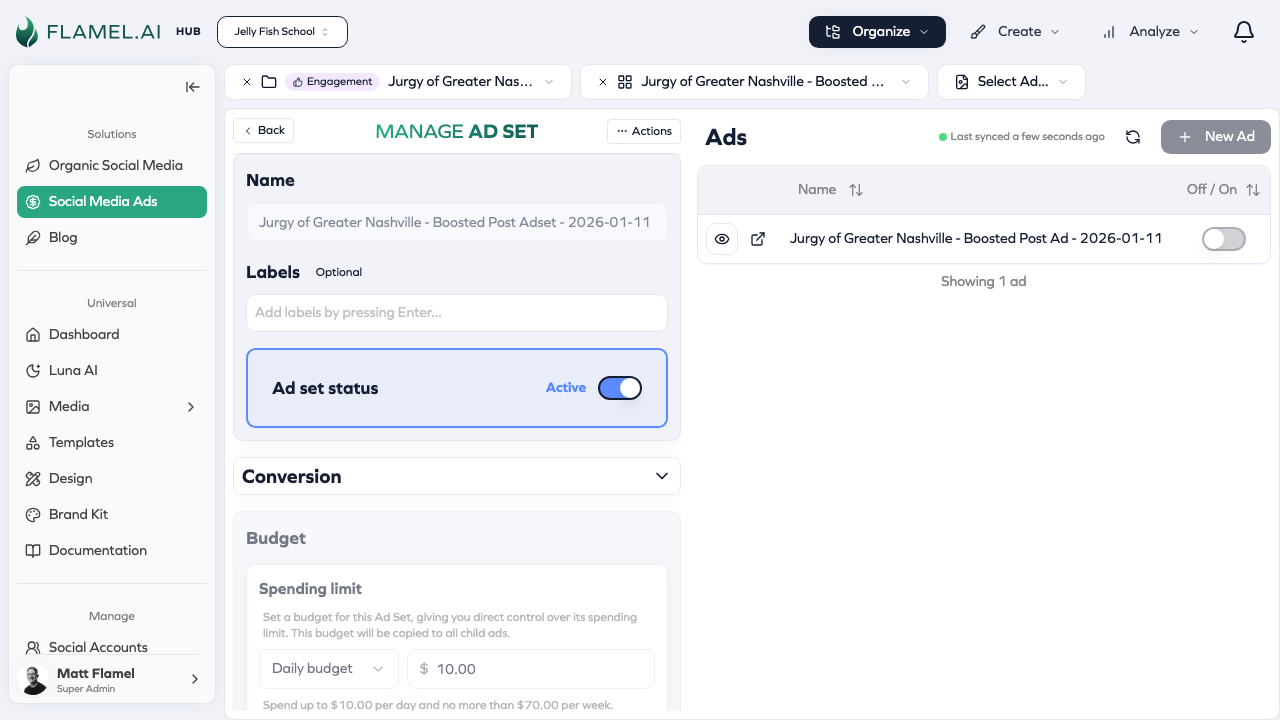
Within an ad set, click Add Ad to create new creative. The builder walks you through selecting your format, adding media, writing copy, and configuring the call-to-action.
Media first — Add your image or video. Pay attention to aspect ratios and resolution. Meta recommends 1080x1080 pixels minimum for images, though higher resolution displays better. For video, keep it short (under 15 seconds often performs best) and ensure the first few seconds grab attention.
Write compelling copy — Your ad copy has several components that work together. The primary text appears above your image and carries the main message. The headline appears below the image in bold and should hook attention. The description provides additional context but may be truncated depending on placement.
Set your destination — Where do people go when they click? Enter the URL and ensure the landing page delivers on what your ad promises. Mismatched expectations tank conversion rates.
Choose a call-to-action — The button text signals what happens when someone clicks. Match it to your actual objective: "Learn More" for information, "Shop Now" for products, "Sign Up" for newsletters, "Get Quote" for services.
Writing Effective Copy
Each copy element serves a different purpose in the ad experience.
Primary text is your main pitch — the message you want to convey. You have up to 125 characters before truncation on most placements (though more may show). Lead with your strongest hook since many people won't read past the first line.
Headline competes with the image for attention. It should be punchy and clear — what's the offer, what's the benefit, why act now? Avoid generic headlines that could apply to any business.
Description provides supporting detail. It may not always display depending on placement, so don't put critical information here. Use it to reinforce credibility, add urgency, or include details that didn't fit above.
Manual vs. Dynamic Creative
When building ads, you choose between manual and dynamic approaches.
Manual creative means you specify exactly what combination shows — this image with this headline with this primary text. What you build is what people see. This gives you complete control and works well when you have specific, tested combinations.
Dynamic creative lets you upload multiple headlines, multiple text options, and multiple images. Meta then mixes and matches to find the best-performing combinations. This is powerful for testing but means you don't control exactly what pairs with what. Ensure any combination makes sense.
Dynamic creative shines when you have many creative assets and want to learn which elements drive performance. Manual creative wins when you have a single strong concept you want to execute precisely.
Previewing Your Ads
Before launching, preview how your ads appear across different placements. The preview tool shows your creative in context — Facebook Feed, Instagram Feed, Stories, Reels — so you can catch problems before spending money.
Check that images aren't cropped awkwardly, text is readable, and the overall impression matches your intent. Stories format is vertical; Feed is square or landscape. An image that looks great in Feed might have important elements cut off in Stories.
Image and Video Best Practices
Strong visuals stop the scroll. Use high-quality, well-lit images that clearly show what you're advertising. People in images often outperform products alone because they create emotional connection. Show your product or service in use, not just in isolation.
For video, hook viewers in the first three seconds — that's often all you get before they scroll past. Assume videos will autoplay muted and ensure they work without sound (use captions or text overlays). Keep mobile viewing in mind; don't rely on small details that work on desktop but disappear on phones.
Avoid stock photos that scream "stock photo." Authentic images of your actual location, team, or customers perform better than generic alternatives, even if the production value is lower.
Copy Best Practices
Write like a human, not a marketing department. Conversational tone outperforms corporate speak. Address the reader directly ("you") rather than talking about hypothetical people ("customers").
Lead with benefit, not features. "Save 2 hours every week" beats "Advanced automation features." People care about what they get, not what you built.
Create urgency when appropriate. Time limits, limited quantity, or expiring offers give people a reason to act now rather than saving your ad for "later" (which means never).
Test different approaches. What works for one audience may not work for another. The only way to know what resonates is to test variations and learn from performance data.